Grass cut work orders are the backbone of a lot of property preservation businesses, and for good reason. During the growing season, a vendor with a solid portfolio of properties can be running fifty, seventy, even a hundred re-cuts every month on top of new initial cuts coming in regularly. At that volume, lawn maintenance becomes one of the most consistent and predictable revenue streams in this entire industry.
But here is what I have learned over thirteen years: grass cuts look simple right up until the moment they are not. The measurement is wrong. The lot size threshold triggers a bid requirement the vendor did not realize was coming. The re-cut gets processed under the wrong frequency for that state. The photos do not meet the before-and-after standard. The initial cut gets invoiced at the wrong lot size tier and comes back adjusted.
None of these are complicated problems. They are all avoidable with the right knowledge. And this guide covers all of it, from how to measure a lot correctly, to the investor-specific rules you need to know cold, to how to submit a grass cut work order completion that moves through the system cleanly the first time.
What a Grass Cut Work Order Actually Covers
Before getting into the details, it is worth being precise about what the standard grass cut allowable actually includes, because vendors sometimes try to invoice line items separately that are already bundled into the allowable.
The standard grass cut allowable includes the cut itself, edging along hard surfaces like sidewalks and driveways, trimming around foundations, fences, trees, bushes, and planting beds, and the disposal of all clippings and incidental debris in the legally permitted manner for that community. All of these are included in the single grass cut allowable fee. You do not invoice them separately. Shrub trimming is a separate cost allowable, as is snow removal. Everything else associated with a standard grass cut is bundled.
Knowing this matters when you are pricing a job. If you are expecting to invoice trimming and edging on top of the grass cut rate, you will be disappointed. Build your per-cut pricing around the total time required to do the complete job, not just the mowing itself.
Initial Cuts vs Re-Cuts: Understanding the Difference
These are two distinct work order types with different rules, different frequencies, and different invoicing structures. Treating them the same is one of the most common processing errors I see from vendors who are new to lawn maintenance work.
The Initial Grass Cut
An initial grass cut is the first grass cut performed at a property that has been determined vacant or abandoned. It is a one-time service per property per season, or per calendar year depending on investor type, and it is typically issued alongside or shortly after an initial secure work order when the property first enters the preservation pipeline.
Under HUD FHA guidelines, grass should typically be cut to a maximum of two inches in length. Before and after photographs are always required for the initial grass cut. If the grass is six inches or higher when you arrive, that is a qualifying condition for the initial cut. If the grass is below six inches and it is outside the standard grass cut season, you need prior written approval from the M&M contractor before proceeding.
Under Fannie Mae guidelines, one initial grass cut is allowed per calendar year. Initial grass cuts are performed on lots up to 15,000 square feet within the standard allowable. If the lot size exceeds 15,000 square feet, specific rules apply that I will cover in the lot size section below.
The initial cut is also where your first documentation of the property’s exterior condition becomes part of the permanent record. Your before photos are not just proof you did the work. They establish the baseline condition of the lawn and exterior at the time of the first service.
Re-Cut Work Orders
Re-cuts are the recurring grass cuts that follow the initial cut throughout the growing season. This is where the volume lives for most vendors doing lawn maintenance work. A property that came into the pipeline in April might need re-cuts every two weeks through October, meaning you could service that single property eight to twelve times in a season.
The frequency rules for re-cuts are investor-specific and state-specific, and this is where vendors get tripped up most often. The general standard under HUD FHA guidelines is that grass should be cut twice a month between April 1 and October 31. However, there are state-level variations that override that general rule.
Under Fannie Mae guidelines, re-cuts follow a schedule defined in their Grass Cut Schedule table by state. Some states allow re-cuts from April through November. Others have shorter seasons. A few states like Alaska have re-cuts running from June 1 to September 30, with a maximum of twice per month. States like Colorado, Utah, and Wyoming allow only once per month between April 1 and October 31. States with warm climates like Florida, Louisiana, Mississippi, South Carolina, and Texas require prior approval for certain cut frequencies and have their own variation schedules.
The point is this: before you set up a recurring re-cut schedule on any property, pull the grass cut schedule for that specific investor and that specific state. Do not assume the standard twice-a-month rule applies everywhere. Submitting re-cuts at a frequency that does not match the approved schedule for that state is how you end up with invoices that get reduced or rejected, and a lot of work done that you will not get fully paid for.
Lot Measurement: How to Do It Correctly
Accurate lot measurement is the foundation of correct invoicing on grass cut work orders. Get this wrong and everything downstream, the tier you invoice at, the bid threshold you trigger, the allowable you are entitled to, is wrong.
Here is what you need to know about measuring lots for property preservation purposes.
Why the County Assessor Record Is Your Starting Point, Not Your Finish Line
The first place most experienced vendors check is the county assessor or county GIS records for the property. Most counties maintain publicly accessible parcel databases that include the recorded lot size in square feet. This is free, takes about two minutes to access by searching the property address on your county assessor’s website, and gives you a documented, legally recorded lot size you can reference in your bid.
However, county assessor records have limitations. They record the total parcel area, including the footprint of the structure, driveways, patios, and any areas that are not actually grass. The gross lot size is not the same as the mowable area. If a 20,000 square foot lot has a 2,500 square foot house footprint, a 1,200 square foot driveway and concrete area, and a 400 square foot deck, your actual mowable area is closer to 15,900 square feet, which puts you in a different pricing tier than the gross lot size would suggest.
This distinction matters for both invoicing accuracy and bid submission. Always note in your documentation whether your stated square footage is the total lot or the mowable area, and be consistent in how you apply that distinction when invoicing.
Google Earth Pro for Satellite Measurement
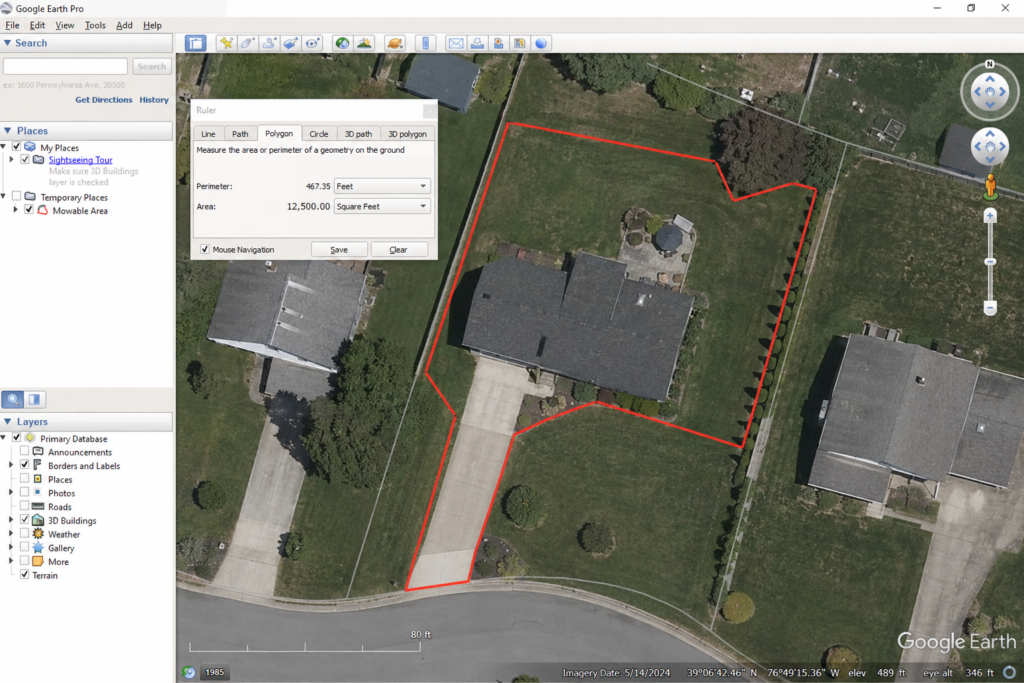
Google Earth Pro is a free download and one of the most widely used tools for lot measurement in property preservation and lawn care. It includes a measurement tool that lets you plot points along the perimeter of a property and calculates the enclosed area in square feet and acres.
To measure a lot in Google Earth Pro, zoom in to the property address, use the polygon measurement tool to trace the perimeter of the mowable area, and read the calculated square footage. The accuracy is generally within two to five percent of actual ground measurements for most standard residential lots, which is sufficient for invoicing purposes.
The additional advantage of Google Earth Pro over a simple parcel record is that you can see the property from above and trace the actual mowable area while excluding the structure footprint, driveways, and other non-grass surfaces. You can also use Street View to assess the property before your first visit, which tells you a lot about what you are walking into.
One important limitation to be aware of: Google Earth satellite imagery is not always current. For properties in fast-developing areas, the imagery can be months or even a couple of years old. Structures or improvements added after the imagery date will not appear. Always verify your satellite measurement against what you actually observe on-site, particularly for initial cuts where you are documenting the property for the first time.
Your County GIS System
Most county governments maintain a GIS (Geographic Information System) parcel viewer that is publicly accessible online. These systems often include higher-resolution imagery than Google Earth, current aerial photography, and precise parcel boundary overlays that make lot measurement significantly more accurate for irregular or non-standard lots.
The additional benefit of the county GIS system is that the parcel boundary data is legally recorded information. When your measurement is derived from the official parcel boundary shown in the county GIS, it is much harder for a reviewer to dispute the lot size you are claiming. This is particularly useful for over-allowable bid submissions on large lots where the reviewer is questioning your measurement.
Search for your county name followed by “GIS parcel viewer” or “property search” to find the appropriate tool. Most are free to use and require only the property address to pull up the parcel data.
On-Site Measurement for Complex or Large Properties
For properties with irregular shapes, significant grade changes, multiple structures, or large tracts that approach or exceed one acre, on-site physical measurement remains the most reliable method. A measuring wheel is the standard tool for this. Walk the perimeter of the mowable area and record the dimensions. For irregular shapes, break the lot into rectangles or triangles, measure each section separately using length multiplied by width for rectangles, and add the results together.
For very large lots, a laser rangefinder significantly speeds up on-site measurement. Good quality laser rangefinders accurate to within a foot or two are available for under $200 and will pay for themselves quickly if you are regularly working large properties.
The on-site measurement is also your opportunity to document conditions that satellite imagery cannot capture: gate widths that may limit mower access, slopes that affect your time estimate, areas of the lawn that are inaccessible due to debris or structural damage, and any conditions that should be noted in your bid if the scope goes beyond the standard allowable.
Fannie Mae Lot Size Rules and the 15,000 Square Foot Threshold
This is one of the most commonly misunderstood areas of grass cut work order processing under Fannie Mae, and getting it right has a direct impact on your invoicing.
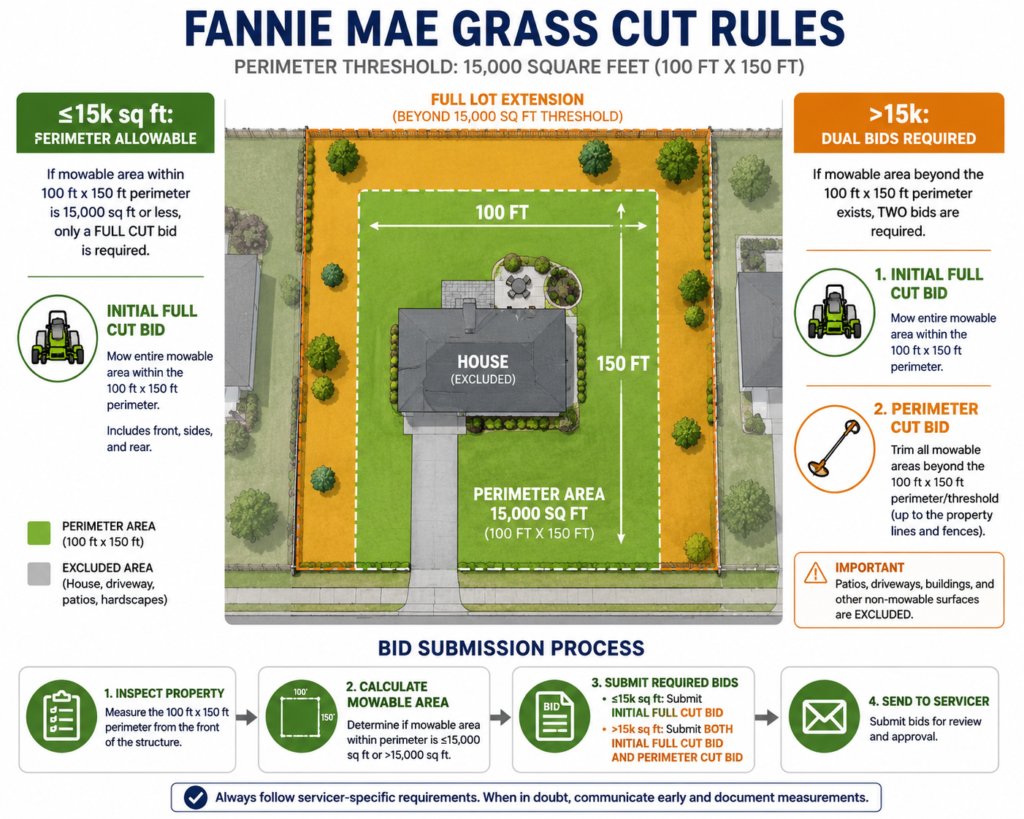
Under current Fannie Mae guidelines, initial grass cuts are to be performed on lots up to 15,000 square feet within the standard allowable. Fannie Mae defines the perimeter cut area as 100 feet by 150 feet, which equals 15,000 square feet.
When the lot size exceeds 15,000 square feet, you do not simply proceed and invoice at the higher lot size tier. Instead, Fannie Mae requires the servicer to simultaneously submit bids for both the initial full lot cut and subsequent cuts, and for the initial perimeter and subsequent perimeter cuts. Both bids go in together, not separately. This is a specific procedural requirement that catches vendors and servicers who are not familiar with the rule.
For re-cuts on lots exceeding the allowable size, prior approval is required before proceeding on work that falls outside the standard lot size thresholds. The re-cut must be completed within the allowable lot size tier for your state before any over-allowable work is invoiced. Failure to submit the correct bid structure for large lots is one of the most common reasons grass cut bids on Fannie Mae properties come back disputed.
HUD FHA Grass Cut Rules: What the Guidelines Actually Say
HUD’s FHA property grass cut requirements are documented in their Yard Maintenance General Requirements guidance and have some specific language that every vendor working on FHA properties should know.
Grass and weeds must be cut to the edge of the property line and to a maximum of two inches. They must also be trimmed around foundations, bushes, trees, and planting beds, and must be trimmed flush with fences and other construction that would normally require trimming. All of this is included in the standard cut allowable.
Grass should not be cut between November 1 and March 31 unless prior written approval is obtained from the M&M contractor. This off-season restriction is strictly enforced. If you receive a grass cut work order in December and proceed without written approval, you are doing unauthorized work.
Under circumstances where the foreclosure process exceeds twelve months and the mortgagee is in compliance with reasonable diligence requirements, an initial grass cut will be allowed once per twelve-month period. No more than one initial lawn cut will be reimbursed per twelve-month period under FHA guidelines.
A final grass cut must be completed within two weeks of conveyance if conveyance occurs during the growing season. This final cut before conveyance is a HUD requirement and the deadline is firm. Missing it means the property does not meet conveyance condition on the lawn maintenance requirement.
One more FHA-specific rule that affects vendors: mortgagees are not to order lawn maintenance for properties such as condominiums where yard maintenance is covered by the homeowners association. Before processing any grass cut on a condominium or townhome property, verify that HOA coverage does not apply. Submitting a grass cut invoice on an HOA-maintained property is a compliance error.
Photo Requirements for Grass Cut Work Orders
This is straightforward but non-negotiable, and it is the area where grass cut completions most commonly get kicked back.
Before and after photographs are required for the initial grass cut, the final grass cut before conveyance, and any off-season grass cut. For standard re-cuts, before and after photos are still required by most nationals even when the guidelines do not explicitly mandate them for every cycle. The safe approach is to take them every time. The cost is thirty seconds of your time per cut. The cost of a disputed completion without photos is the entire cut fee.
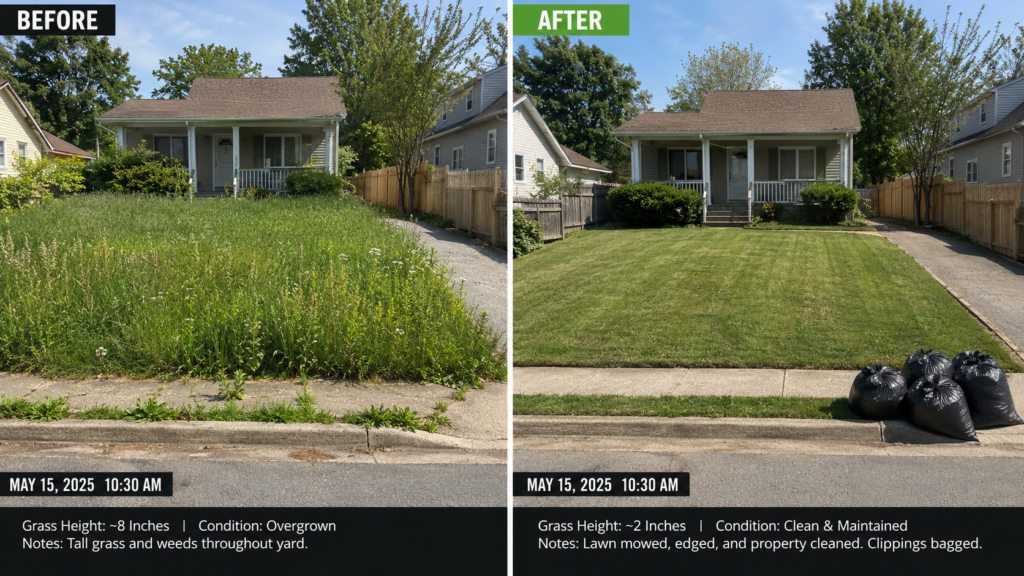
Your before photo must be taken before you start the mower. Your after photo must be taken after the full job is complete, including edging and trimming. Both photos must be dated and timestamped and should be taken from the same position so the comparison is clear. A street-facing shot showing the front yard and a rear yard shot showing the back yard are the minimum standard for most clients.
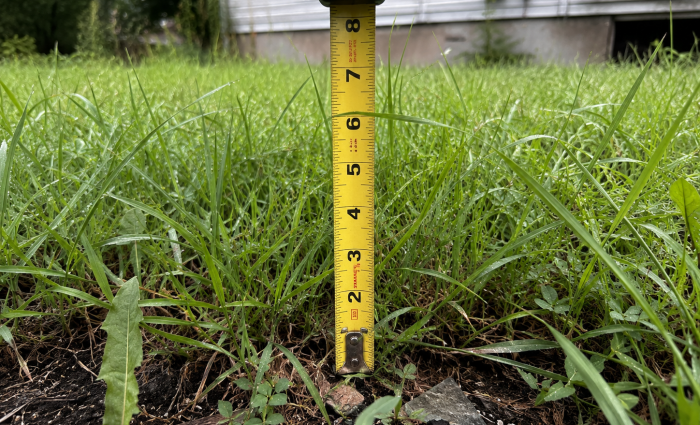
For initial cuts on heavily overgrown properties, take additional photos showing the specific height of the grass before cutting. A photo showing the grass height against a measuring tape or reference object strengthens your documentation considerably if the before condition is part of a bid justification for an over-allowable cut.
When a Grass Cut Requires a Bid
Most standard grass cuts fall within allowable pricing and do not require a bid submission before completing the work. But there are specific situations where a bid is required, and proceeding without one is a compliance error that creates payment disputes.
Lots exceeding the standard allowable size require an over-allowable bid as described in the Fannie Mae section above. Know your client’s per-investor lot size thresholds and have your measurement ready before you start the job.
Off-season grass cuts require prior approval under HUD FHA guidelines. If you believe an off-season cut is genuinely needed due to unusual growth, document the grass height with photos, submit the request for prior approval, and wait for written authorization before proceeding.
Overgrown conditions requiring more than a standard cut may justify a bid for additional work beyond the standard allowable if the property has not been maintained and requires multiple passes, significant trimming beyond standard scope, or equipment that is not standard for a routine cut. Document the condition thoroughly with photos and submit a bid for the additional scope before starting.
Shrub trimming is always a separate line item and requires a bid if it exceeds the allowable. Do not bundle shrub trimming into your grass cut invoice. It is a distinct service with its own pricing tier and its own documentation requirements.
Scheduling Re-Cuts for Maximum Efficiency
I want to spend a moment on this because it directly affects your profitability on lawn maintenance work, and most guides skip over it entirely.
Re-cut work orders at moderate volume, say fifty to a hundred properties, are only profitable if your routing is efficient. A vendor spending forty minutes driving between properties that could be clustered into fifteen-minute routes is working twice as hard for the same revenue. Geographic clustering of your re-cut schedule is one of the most impactful operational decisions you can make during lawn maintenance season.
Group your properties by neighborhood or ZIP code and schedule them on the same day in a loop route. Use Google Maps or any routing tool to sequence the stops efficiently before you leave in the morning. Keep your equipment in the best possible condition, especially mower blades. Dull blades slow you down, produce a worse cut quality, and create photos that look ragged in your after documentation. Experienced vendors in this business average about twenty minutes per re-cut on a standard residential property when they are running efficiently. That is the benchmark to aim for.
Track your time per property over a season and identify the outliers. Properties that consistently take significantly longer than your average either need to be re-priced if possible or declined if the economics do not work. Lawn maintenance is a volume game. Your margin lives in your efficiency.
Work Order Completion Processing: Where Grass Cuts Lose Money at the Back End
The field work on grass cuts is the easy part. The back-office processing is where a high volume of these jobs creates a real operational burden that vendors often underestimate.
Every grass cut completion needs photos uploaded to the client portal in the correct order, the completion form filled out accurately for that specific client’s system, the correct lot size tier selected, any bid submissions for over-allowable work attached with supporting documentation, and the work order status updated and submitted for review. For a vendor completing twenty re-cuts in a day, that is twenty separate portal submissions, each with their own photo sets and completion data.
When that processing gets rushed or falls behind, errors compound quickly. The wrong lot size tier gets selected. Before photos get attached to the wrong property. A bid that should have gone in with the initial cut gets missed and submitted late. The re-cut frequency does not match the state schedule in the system. These are not catastrophic errors individually, but across a portfolio of properties over a full season, they add up to real money in reduced payments and disputed invoices.
This is the exact type of high-volume, detail-oriented processing work that AssetSure Processing handles for vendors running active lawn maintenance portfolios. Managing the portal submissions, photo documentation, completion forms, and bid submissions for grass cut work orders at volume is something our team does daily. It takes the processing load off your plate so you can stay focused on running your field operation efficiently during the season when the work is heaviest.
If you are heading into lawn maintenance season with a growing portfolio and you know the back-office side is going to be a bottleneck, it is worth solving that before your first round of re-cuts hits, not after you are already behind.
Reach out to AssetSure Processing to talk about how we support vendors through lawn maintenance season and what that looks like in practice.